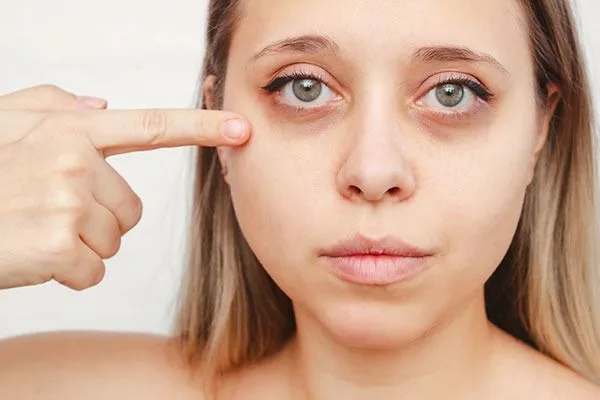
A hollow under the eye is a depression between the lower eyelid and the cheekbone, in the area known as the tear trough. It results from the loss of the fat pad under the eye and the pull of a ligament that anchors this depression, which casts a shadow under the eye.
It is different from pigmented under-eye circles, caused by excess melanin, and from vascular under-eye circles, caused by veins showing through thin skin. These three forms do not call for the same treatments. Hyaluronic acid filler remains the reference treatment for hollow under-eyes, with a result that lasts 12 to 18 months.
Lipofilling lasts longer, but it is a surgical procedure. In Geneva, under-eye hollow injections start at 650 CHF.
- Hollow, pigmented, vascular: three different under-eye problems
- Hollow under-eyes: a matter of volume and shadow
- Pigmented circles: excess melanin under the eye
- Vascular circles: veins showing through the skin
- And under-eye bags, a separate problem
- Why under-eyes become hollow over time
- How a doctor determines the cause of your under-eye circles
- Hyaluronic acid: the reference treatment for hollow under-eyes
- Why a lightly cross-linked gel is essential under the eyes
- Tyndall effect, swelling and overcorrection: the limits to know about
- Alternatives when hyaluronic acid is not the right answer
- Lipofilling: your own fat for a longer-lasting result
- Blepharoplasty: when the hollow is not the real problem
- Pigmented and vascular circles: peels, laser and sun protection
- How long does under-eye correction last, and what does it cost in Geneva?
- FAQ – Frequently asked questions about hollow under-eyes
- In conclusion
Hollow, pigmented, vascular: three different under-eye problems
This is the starting point of any serious treatment. A treatment that works on one form is ineffective, or even counterproductive, on another. And the three types often coexist in the same patient, which explains many disappointing results.
Hollow under-eyes: a matter of volume and shadow
Here, the colour is only a consequence. The depression under the eye catches the light and casts a shadow that darkens the area. The test is simple: when the face is lit evenly from the front, the darkness clearly fades. The problem is one of structure, not pigment.
Pigmented circles: excess melanin under the eye
The skin under the eye has a higher concentration of melanin, often constitutional and common in Mediterranean, Middle Eastern or North African skin types. The colour is brown and even, and does not change with the lighting. Sun exposure and rubbing make it worse.
Vascular circles: veins showing through the skin
The skin of the lower eyelid is among the thinnest in the body. As it thins further with age, the veins underneath become visible and give a bluish or purplish tint. Tiredness and lack of sleep make this more noticeable by dilating the vessels, without being the cause.
And under-eye bags, a separate problem
Bags are caused by a herniation of the fat around the eye, which pushes the eyelid forward instead of hollowing it. The issue is too much volume, not too little. Filling an area that already has bags makes them protrude more and weighs down the eyes. It is the most common treatment error in this area.
Why under-eyes become hollow over time
The fat pad that protects the eye loses volume over the years, while the fat pad of the cheek descends slightly. Between the two lies the orbitomalar ligament, which stays attached to the bone and holds the boundary in place.
This anchor point turns a gradual loss of volume into a distinct groove. Thinning skin and declining collagen add to this, making the contours more pronounced. Facial structure also plays a part: a prominent orbital rim or a flat cheekbone can make the area hollow from a young age, sometimes at twenty.
This is also why sleep and creams do nothing for a hollow under-eye. They act on fluid retention and skin quality, not on a loss of volume and a ligament attachment.
The French Society of Dermatology also points out that the area around the eyes responds poorly to topical products because of its structure.
How a doctor determines the cause of your under-eye circles
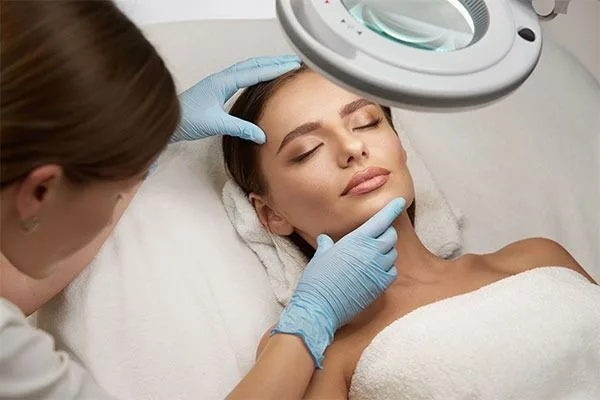
The examination is done under raking light and then under frontal light, to tell shadow apart from pigmentation.
Gently stretching the skin shows how elastic it is and whether there is excess skin.
The position of the cheek fat pad and the projection of the cheekbone are assessed, because an isolated under-eye hollow and ageing of the whole mid-face do not call for the same response.
This distinction is decisive. Treating an under-eye hollow on its own when the whole mid-face has lost volume gives an unbalanced result, with a filled area that contrasts with a flat cheekbone.
Everything else follows from this examination: the treatment depends on what the doctor observes, not on what the patient has read or seen elsewhere.
Hyaluronic acid: the reference treatment for hollow under-eyes
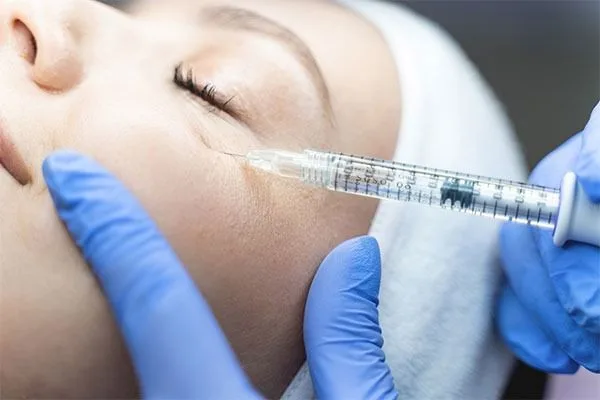
Under-eye hollow injection with hyaluronic acid fills the depression and removes the shadow. A meta-analysis of more than 2'500 patients, published on PubMed, found a satisfaction rate of around 91 %, with complications that were mostly minor and temporary.
What to remember about its scope: the product corrects a lack of volume. It does not act on pigmentation. On a dark circle, it can indirectly reduce the dark appearance by removing the shadow, but it does not lighten pigment. Knowing this avoids many disappointments.
Why a lightly cross-linked gel is essential under the eyes
The area under the eye tolerates volumising hyaluronic acids very poorly. These highly cross-linked gels attract water and cause persistent swelling, sometimes for several months. On such thin skin, they can also create visible bumps.
A lightly cross-linked gel with low water affinity, by contrast, blends in discreetly. The choice of product matters as much as the technique here, and it is one of the things that sets apart a practitioner experienced in this area.
Tyndall effect, swelling and overcorrection: the limits to know about
The Tyndall effect shows as a blue-grey tint when the product has been placed too superficially: blue light scatters as it passes through the gel under thin skin. The meta-analysis cited above found it in about 0.9 % of cases.
Swelling over the cheekbone (malar oedema) is more common, in around 19 % of cases, and usually temporary. Overcorrection causes a puffy look that lasts as long as the product remains.
Then there is the vascular risk. Rare but real, it comes from an injection into an artery in an area with a rich blood supply, close to the eye. This is why the injector must be a doctor trained in this area, and why we regularly warn about injections carried out outside a medical setting. Our injections FAQ answers the most common safety questions.
Lipofilling: your own fat for a longer-lasting result
Lipofilling (fat grafting) involves taking fat from the patient, purifying it and then reinjecting it into the hollow area. A refined variant, micro-lipofilling, uses finer particles suited to the thin skin of the eyelid.
30 to 50 % of the injected volume is always reabsorbed in the first few months.
What remains, however, integrates for the long term, with no yearly maintenance. The trade-off is the nature of the procedure: it is surgery, performed as a day case, with a more noticeable recovery than an injection in the consulting room.
We consider it for patients looking for a long-term correction, or when fillers are poorly tolerated.
Blepharoplasty: when the hollow is not the real problem
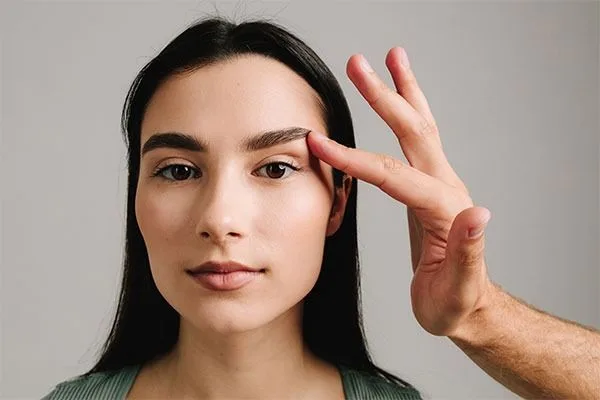
When there are also bags, or the skin shows marked excess, filling makes the result worse. Lower blepharoplasty then treats the cause: repositioning or removing the herniated fat and adjusting the skin. It can also be combined with filler at a later stage.
For moderate excess skin without fat herniation, Plexr offers a non-surgical alternative. Our article on drooping eyelids sets out the criteria for deciding.
Pigmented and vascular circles: peels, laser and sun protection
Where pigment is involved, the approach relies on peels adapted to the thin skin of this area, prescribed depigmenting products, and strict daily sun protection.
Treatment of pigment spots follows much the same logic as described in our article on pigment spots and melasma, with gentler settings given how close the area is to the eye.
Where the cause is vascular, results are more modest. Improving the thickness and quality of the skin remains the main approach, without expecting the veins to stop showing through.
How long does under-eye correction last, and what does it cost in Geneva?
Hyaluronic acid filler in the tear trough lasts 12 to 18 months on average, sometimes longer, as the product breaks down slowly in this area with little movement. Lipofilling works on a different timescale, with part of the volume permanently integrated after the reabsorption phase.
At the Clinique de la Croix d'Or, under-eye hollow injections start at 650 CHF, and dissolving with hyaluronidase, if needed, from 300 CHF. Details are on our face rates page. These are aesthetic procedures and are not covered by basic health insurance.
A word of caution about results. The eyes look rested and the shadow fades clearly, but it would be inaccurate to speak of the under-eye circle disappearing completely, especially when pigment or blood vessels are involved. The effect is visible straight after the session, then settles over two to three weeks once the initial swelling has gone down. Our face gallery gives a concrete idea of what can be achieved.
FAQ – Frequently asked questions about hollow under-eyes
Can hyaluronic acid get rid of a brown under-eye circle?
What if I am not happy with the result?
How long do under-eye injections last?
Are the results visible straight away?
Are under-eye injections painful?
From what age can hollow under-eyes be treated?
In conclusion
Correcting an under-eye circle for the long term starts with knowing which kind it is. Hollow, pigmented, vascular or combined with bags: each calls for a different answer, and the wrong treatment will at best do nothing and at worst make things worse.
The area around the eyes is also one of the most technically demanding in the face, with a vascular risk that requires a doctor trained in this area. At the Clinique de la Croix d'Or in Geneva, our doctors assess the eye area and guide you towards the solution suited to your anatomy.
Book a first consultation to talk it through.
Book an appointment
Hollow, pigmented or vascular under-eye circles: each type needs a different treatment. At the Clinique de la Croix d’Or in Geneva, the first consultation starts with an assessment of the eye area by a doctor, under raking light and then frontal light, to understand what is causing your under-eye circles.
The doctor then explains the options suited to your anatomy, from hyaluronic acid to lipofilling, and answers your questions about results and recovery.
Book an appointment to talk it through. Under-eye hollow injections start at 650 CHF. See all our rates here.
Contact us to discuss what you need:
- By phone: +41 (0)22 736 50 50
- By email: contact@cliniquedelacroixdor.ch