Gynecomastia is the abnormal development of the breast gland in men. It is a benign and common condition, most often linked to an imbalance between oestrogen and testosterone.
It must be distinguished from adipomastia, which is simply excess fat, because this difference determines the whole treatment. When a cause is identified, correcting it may be enough. Medical treatment is sometimes useful if the gynecomastia is recent. When it is established and bothersome, surgery remains the reference solution.
At the Clinique de la Croix d'Or, care always begins with a clinical examination to determine precisely which tissue is involved.
- What is gynecomastia in men?
- True gynecomastia or adipomastia: how to tell the difference?
- Gynecomastia and bodybuilding: the role of anabolic steroids
- What causes gynecomastia?
- How is gynecomastia diagnosed?
- How can gynecomastia be treated? The options
- When is surgery indicated?
- Surgical treatment of gynecomastia in Geneva
- Frequently asked questions about gynecomastia in men
- In conclusion
What is gynecomastia in men?
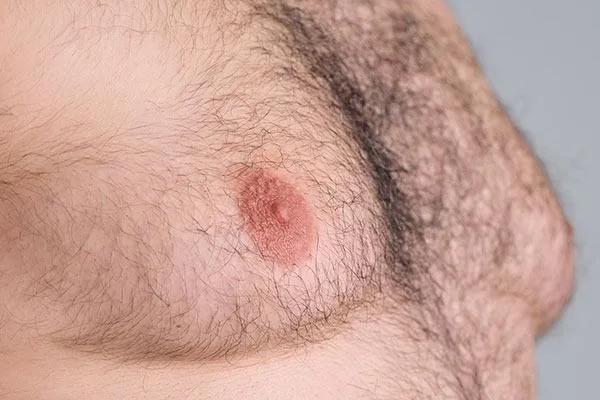
Gynecomastia is an enlargement of the male breast gland. In men, this gland exists but normally remains in a rudimentary state. Under certain hormonal conditions, it can develop, on one side or both.
The central mechanism is an imbalance between the female hormones, oestrogens, and the male hormone, testosterone. When the balance tips towards oestrogens, the glandular tissue starts to grow. This condition is benign and much more common than people think, affecting a large proportion of men at some point in their lives, particularly during adolescence and after the age of fifty.
It affects morale as much as the body. Many men find it hard to live with and do not dare to see a doctor, even though solutions exist.
True gynecomastia or adipomastia: how to tell the difference?
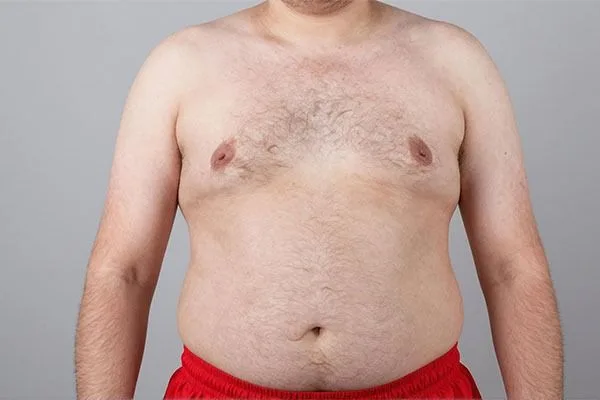
This is the most important distinction, because it changes everything. True gynecomastia is a development of the gland. On palpation, there is a firm mass, centred on the areola, sometimes tender. Adipomastia, also called pseudogynecomastia, is only a fat deposit: it feels soft and diffuse, and is not centred on the nipple. The two can coexist, in which case it is called adipo-gynecomastia.
This difference directly guides the treatment. Adipomastia linked to excess weight often regresses with weight loss or liposuction. True glandular gynecomastia, on the other hand, does not melt away with exercise or dieting, and calls for a different procedure. This is why you should not rely on outward appearance alone.
Gynecomastia and bodybuilding: the role of anabolic steroids
One particular case deserves a mention, as it comes up often in young, active men. Taking anabolic steroids, as happens in some bodybuilding circles, disrupts the hormonal balance and can trigger true gynecomastia.
The body converts part of these hormones into oestrogens, which stimulates the breast gland. Contrary to a widespread belief, this is not fat linked to training but glandular tissue which, once established, does not go away with more training.
What causes gynecomastia?
In a large share of cases, no specific cause is found: this is called idiopathic gynecomastia. When there is a cause, several possibilities are explored.
The first is hormonal and physiological. Gynecomastia in newborns and in adolescents is temporary and often disappears on its own within a few months. In older men, the age-related fall in testosterone makes it more likely to appear.
Next come medicines and substances: certain treatments, the anabolic steroids mentioned above, and cannabis. Finally, more general illnesses affecting the liver, kidneys or thyroid can be involved.
More rarely, a hard, one-sided lump calls for investigation of the testicle or breast, which is why recent, asymmetrical gynecomastia should never be dismissed.
How is gynecomastia diagnosed?
Diagnosis is based first on the clinical examination. The doctor palpates the chest to determine whether it is gland, fat or both, and checks whether it is symmetrical. This step is often enough to decide on the approach.
Depending on the situation, hormone tests and a breast ultrasound may complete the examination, particularly in a young man with no obvious cause or when there are atypical signs. A hard lump that is one-sided, fixed or accompanied by discharge leads to further tests to rule out a tumour. This process reassures the vast majority of patients, in whom gynecomastia is entirely benign.
How can gynecomastia be treated? The options
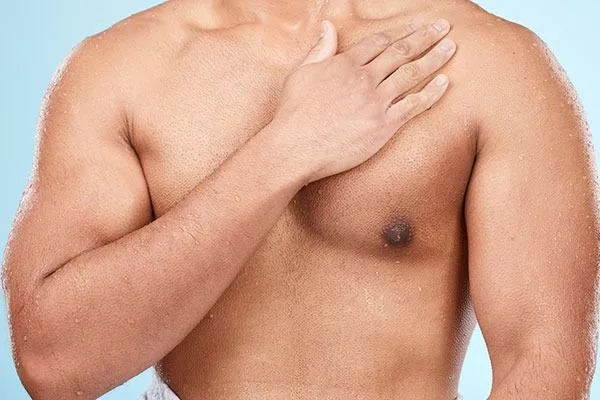
The first question is the cause. When it can be identified, treating it or removing the trigger, a medicine for example, sometimes leads to complete regression.
Medical treatment is mainly useful when the gynecomastia is recent.
Drugs that act on oestrogens can reduce the size of the gland, but their effectiveness drops sharply after it has been present for more than a year, once the gland has become fibrous. For adipomastia, weight loss remains the logical first step.
When is surgery indicated?
When gynecomastia is established, long-lasting and a source of discomfort, surgery becomes the reference solution. It is the only way to remove fibrous glandular tissue that no longer responds to exercise or medication. The decision is based on physical and psychological discomfort, not simply on aesthetic preference.
Surgical treatment of gynecomastia in Geneva
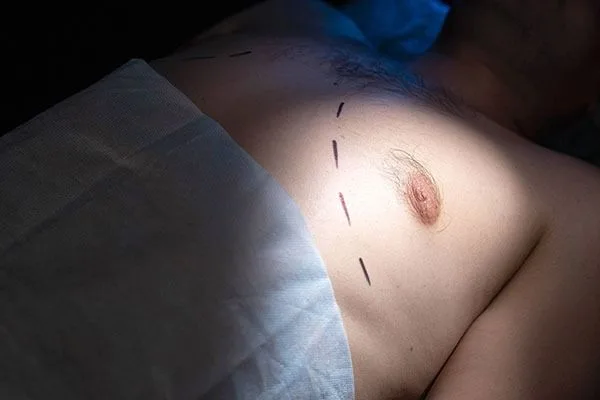
Surgical correction of gynecomastia usually combines two procedures: liposuction to remove the fatty component, and removal of the gland through a short incision hidden at the edge of the areola. The aim is to give the chest a balanced contour while leaving a discreet scar. The operation is usually performed as a day case.
The price depends on the technique, the amount of tissue to remove and the surgical setting. Our rates give these details, to be refined during the consultation. Insurance cover is possible in certain medical situations, but not for a purely aesthetic request: this is assessed case by case.
Frequently asked questions about gynecomastia in men
Can gynecomastia go away without surgery?
Can bodybuilding or protein cause gynecomastia?
Is gynecomastia covered by insurance in Switzerland?
From what age can surgery be performed?
Can gynecomastia come back after surgery?
In conclusion
Gynecomastia is benign but often hard to live with, and its treatment rests on a simple idea: first tell the gland apart from the fat. This distinction, together with the search for a possible cause, determines the right response, from medical follow-up to surgery.
At the Clinique de la Croix d'Or in Geneva, Dr Bachir Athmani examines the chest, identifies the tissue involved and suggests the solution suited to each situation.
To review your own situation, book a first consultation.
Our article on male cosmetic surgery in Geneva also places gynecomastia in the wider context of what men ask for.
Book a first consultation for gynecomastia
Enlarged breasts in men can have several causes: excess breast gland tissue, excess fat, or both.
At the first consultation, the doctor examines the chest, looks for the cause and explains the options suited to your situation.
Fill in this form and our team will get back to you to arrange an appointment at our clinic in Geneva.
Any questions?
Contact us to discuss what you need:
- By phone: +41 (0)22 736 50 50
- By email: contact@cliniquedelacroixdor.ch