Frown lines and forehead lines are expression lines formed by the repeated contraction of the muscles in the upper third of the face.
Frown lines (also called glabellar lines) are the vertical creases between the eyebrows, produced by the corrugator and procerus muscles. Forehead lines are the horizontal creases made by the frontalis muscle when you look surprised or attentive. With age, these creases remain visible even when the face is at rest.
The reference treatment is botulinum toxin, which temporarily relaxes the muscles responsible. Hyaluronic acid can sometimes fill creases that have already become deep. Results usually last 4 to 6 months with botulinum toxin, the treatment we use first for this part of the face.
- Frown lines, forehead lines: what exactly are we talking about?
- Why do frown lines appear?
- Why do forehead lines deepen with age?
- Which treatments soften frown and forehead lines?
- Botulinum toxin: the reference treatment
- Hyaluronic acid: filling deep creases
- Can botulinum toxin and hyaluronic acid be combined?
- At what age should frown lines be treated? Prevention and early treatment
- What the results look like: before and after in Geneva
- See a doctor at the Clinique de la Croix d'Or in Geneva
- Frequently asked questions about frown lines
- In summary
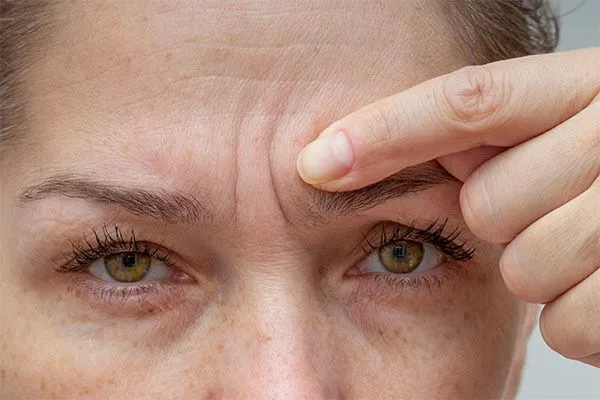
Why do frown lines appear?
A frown line, or glabellar line, is the vertical crease that forms between the eyebrows when you frown or squint. Depending on the shape of the face, it can appear as a single furrow or as two parallel lines. The corrugator muscle, which draws the eyebrows towards the centre, and the procerus muscle, which pulls the skin of the nose upwards, are mainly responsible.
Over the years, these repeated contractions, combined with the gradual loss of collagen, leave a permanent mark. The line first appears as a fine line, then deepens. Unprotected sun exposure, smoking, long hours at a screen and genetics speed up the process.
Why do forehead lines deepen with age?
Forehead lines often appear earlier than frown lines, from the thirties in people with very expressive faces. As the dermis thins with age and the body produces less of its own hyaluronic acid, the skin no longer recovers its suppleness between two contractions. What was a tiredness line becomes a permanent crease.
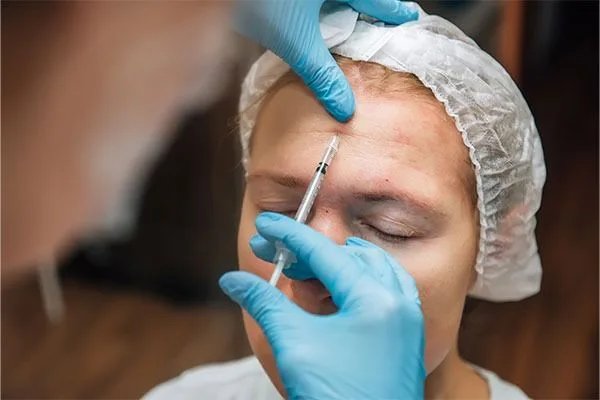
Which treatments soften frown and forehead lines?
Two complementary approaches are available at the Clinique de la Croix d'Or in Geneva: botulinum toxin, which acts on the muscle, and hyaluronic acid, which acts on the crease. To understand the differences between them and which approach to favour, the clinic's injections FAQ answers the most common questions. Depending on the patient's profile and how advanced the lines are, one or the other, or a combination of both, will be recommended.
Botulinum toxin: the reference treatment
Botulinum toxin works by temporarily blocking the signal between nerve and muscle in the targeted muscles. The muscle relaxes, the contraction that causes the line disappears or is greatly reduced, and the skin looks smooth again. Results appear 3 to 7 days after the injection and usually last 4 to 6 months.
For frown lines, the treatment targets the corrugator and procerus muscles. The result is usually very clear: the line softens significantly, or even disappears, depending on its initial depth. For forehead lines, the dose needs particular care. Too high a dose in the frontalis muscle can lower the eyebrows (heavy brows), giving a tired look. An experienced doctor adjusts the doses precisely to each patient's facial anatomy to keep a natural expression.
Hyaluronic acid: filling deep creases
When a line is already deep at rest, even after the muscle is fully relaxed, filling it with hyaluronic acid may be needed. Hyaluronic acid fills the remaining crease by restoring volume locally, completing the work of the toxin.
This approach is particularly suited to deep frown lines that have been there for several years and still show a visible crease even when the muscles are relaxed. The hyaluronic acid used in aesthetic medicine is biocompatible and naturally absorbed by the body. How long it lasts depends on the product and the area: generally 6 to 12 months for the upper third of the face.
Can botulinum toxin and hyaluronic acid be combined?
Yes, and it is often the most effective approach for deep or long-standing lines. The two treatments complement each other: the toxin prevents the muscle contraction that would deepen the line again, and hyaluronic acid fills the remaining crease that muscle relaxation alone cannot smooth out.
The usual sequence is to inject the botulinum toxin first, then assess a few weeks later whether filling is still needed. This two-step protocol avoids injecting too much hyaluronic acid into an area that might smooth out enough once the muscle has relaxed.
At what age should frown lines be treated? Prevention and early treatment
There is no set age to start. The decision depends on how advanced the lines are and how much they bother you, not on an arbitrary age threshold.
For prevention, some patients come to see us from their thirties, when the lines start to remain visible at rest. Treating at this stage has an advantage: smaller doses are needed, the results look more natural, and the line is kept from deepening further. The article on natural-looking facial injections and the right age to start covers this point in detail. As a corrective treatment, the toxin remains effective whatever the depth of the line, but a very old, very deep line will often need to be combined with hyaluronic acid for the best result.
What matters most is to see a doctor who assesses the actual state of the muscles and skin before suggesting a protocol. An overly standardised approach that ignores individual facial anatomy is the main cause of unnatural results.
What the results look like: before and after in Geneva
A well-performed treatment does not freeze the face; it makes it look rested. The eyes look lighter, the lines disappear or soften clearly, and the face stays expressive. Patients often describe looking "less tired" rather than visibly transformed.
Expectations should remain realistic: the toxin treats expression lines, not facial features or the contour of the face. On a very deep line, the improvement will be marked, but not necessarily complete without additional filling. Before and after photos can be shown during the consultation.
The effects last 4 to 6 months. With regular sessions, the muscles gradually get used to contracting less, which can lengthen the interval between two injections.

See a doctor at the Clinique de la Croix d'Or in Geneva
Every consultation starts with a clinical examination of the face: muscle analysis, assessment of how deep the lines are, and a review of skin quality. The protocol is then defined according to what the doctor observes, not according to a set package price.
The aim is a natural result: softening without freezing, keeping the eyes expressive, respecting the proportions of the face. For patients who want to go further, EMFace can complement injections by working on muscle tone and repositioning the framework of the face. Microneedling and peels can improve skin texture and radiance at the same time.
See our face rates or book an appointment online.
Frequently asked questions about frown lines
Is botulinum toxin for frown lines painful?
How much does frown line treatment cost in Geneva?
Is botulinum toxin for forehead lines noticeable? Will I look frozen?
What is the difference between frown lines and glabellar lines?
Do frown lines come back after treatment?
In summary
Botulinum toxin remains the reference treatment for expression lines in the upper third of the face. Hyaluronic acid takes over for deep creases. The result depends above all on the initial diagnosis and the precision of the medical procedure.
Book an appointment at the Clinique de la Croix d'Or in Geneva.

Book your appointment today
Book an appointment today for personalized, high-quality aesthetic treatments. Our team of experts is here to offer you innovative treatments tailored to your needs.
- By phone at +41 22 736 50 50
- Or directly via our online contact form
- Don't miss out on our exclusive offers and news! Subscribe to our newsletter now and be the first to know.